Bodybuilding Forearm Training - The Best Forearm Muscle Exercises
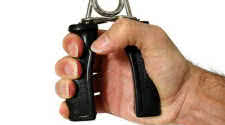
Neglecting your Forearm Training is a Big Mistake
The fact is, most amateur bodybuilders and some pros - don't feel a strong need to train their forearms like any other
bodypart. It's as if the forearms were foreign extensions of the arms that somehow disappear when the time comes to go
to the gym. These guys think the judges are going to be looking at their upper arms splaying out east to west in a
double-biceps pose or locked down like a prison cell in a triceps shot and fail to note their lack of forearms. To these
rocket scientists a hard back day is all that is necessary for building big forearms, or lifting dumbbells to and from the
rack is enough exertion for the lower arms.
Most people do neglect training their forearms, but if your sights are set on competing in a bodybuilding contest,
forearms could be your weak link. Bodybuilding competition is an aesthetic pursuit which demands that all parts be
developed equally, relative to overall structure. Walking onstage with bodyparts unequally developed nets nothing but
a low placing and bewilderment at what went wrong. Most competitors who place 5th, 8th, 10th or 15th believe that because
they worked every bit as hard as the winner, and busted a nut preparing themselves for this one day, they deserve a higher
placing. Judging a physique, however, comes down to determining how nearly complete it is.
Of course, competition involves many variables. Diet, training, water balance, posing, fullness, structure, separation
and overall muscularity are all important. Often, because there is so much to concern oneself with, something is lost in
the details, but the competitor who has overlooked as major a part as an entire lower arm deserves to place anywhere
from second to 17th.
Forearms are a complex set of muscles that intertwine into a bundle similar in size to an entire biceps. Would you do
one-arm cable curls using only your right biceps and deliberately avoid the left? Of course not. Neglecting the forearms
is almost as bad. Compulsory poses don't include forearm flexes, but almost everything you do on the stage indirectly
utilizes the forearms. This is why developing them is so crucial to success in competition. They add the finishing touches
on what might be a great physique.
In deciding how to incorporate your forearm-training into the rest of your workout schedule, consider that training the
forearms should take no longer than 20 minutes at the most. Keep in mind how often you use them indirectly in your workouts.
If you use your forearms a great deal during back workouts - because you don't wear training straps - you might want to
do back and forearms on different days. If you work with heavy dumbbells or barbells for biceps and do not train back and
biceps on the same day, you may want to avoid those days for forearm-training. Choose a stress-free day to train forearms.
Try also to choose a day that doesn't conflict with your ability to properly execute other exercises for primary bodyparts.
You don't want to have sore forearms on a day when you have to train back. It might be safe to do forearms on the day before
legs or a day after working the back. This way, even if your forearms are slightly sore while you are doing triceps exercises,
or working calves and abdominals, your forearm work won't conflict with anything else. Plan your forearm-training in the
same way as when you schedule back work for the day after you do legs. Squatting with a sore back isn't the brightest idea
in the world. Neither is doing forearms on the day before a heavy back workout.
Think of training your forearms as you might schedule your abdominal and calf sessions. You may wish to devote a whole day
to working nothing but calves, abs and forearms because these are all secondary muscle groups that need attention but perhaps
get neglected in favor of workouts for larger bodyparts. Adding forearm exercises to days on which you do only aerobic
training might help you bridge the gap between underdeveloped forearms and thick ropy ones.
Which exercises are effective in building adequate to great forearms? Well, there are several, but we recommend building a
workout around approximately four different exercises that include enough variety to develop all sides of the muscle.
dumbbells, barbell and EZ-curl bar are best for isolating the muscles. However, there are some benefits to training forearms
with a cable pulley. One advantage is that you get more resistance from a cable that is tugging away from the body. Cable
work also allows a greater range of motion. A combination of techniques is best for complete development.
By beginning your forearm-training with a cable, you will enable the forearms to stretch out and get warmed up for harder
work with dumbbells or barbells. Start with a light weight and an underhand grip to work the bulk of the forearm on the
underside. Progressing immediately to an overhand grip is a good way to work the top of the forearm and get the entire
muscle stretched out.
Seated Cable Forearm Crunches
(underhand) Sit on the edge of a bench slightly higher than the origin of the cable. Attach either a short straight bar or an EZ-curl bar that lets you work the forearms in close to the body. Start with a light weight and work your way down the stack. Hold the bar in an underhand grip with wrists flat on your knees, inside facing up. The elbows should be resting toward the top of the thighs, near the hips. Grasp the bar with your fingers, but don't squeeze it tightly. The idea is for the forearms to bear most of the weight. Simply grip the bar so that you won't lose control of it. Curl upward, moving fairly slowly but with a fluid motion, and then lower the weight. To determine sets and reps, go with how your forearms feel after 2 sets of each exercise. Certainly something is always better than nothing, so doing 2 sets per exercise is enough for the first five workouts. Gradually increase your workload as your forearms develop. Try 2 sets of 8 to 10 reps.Seated Cable Forearm Crunches
(overhand) Sit on the end of a bench higher than the origin of the cable. Grasp the bar overhand while resting your elbows on your upper quads and the undersides of your wrists on the edge of your knees. Slowly move your hands and wrists up toward your body. Flex and hold them there for one second. Slowly lower the weight back down, flexing all the way. This exercise works the top of the forearms and sets deep separations into the muscle. You must remember that the forearm consists of two separate sets of muscles and tendons, and both the upside and underside require work. Both muscle groups within the forearm support the flexion of the wrist and movement of the fingers. You may wish to repeat the set and rep scheme of the first exercise, doing 2 sets of 8 to 10 reps to start and progressing to 3 sets of the same number of reps.Standing EZ-Bar Forearm Curls
Unlike the previous two exercises, this movement concentrates on hitting both the upper and underside portions of the forearms. In a standing position take an overhand grip on either an EZ-curl bar or a straight bar with hands approximately six inches apart. Stand with your arms straight and the bar down low. Begin by curling your knuckles under toward your body. Lift the bar, making sure to keep your wrists in this curled-under position as you come up. Hold your elbows in at your sides, and keep your wrists curled over your hands until you reach a point where that position is nearly impossible. Then flip your wrists slowly into the opposite hands-back position. At this point you are at the top of the movement and the bar is in front of your chin. Slowly lower the bar with your wrists in the flipped-back position until you have to curl your wrists under and assume the start position once more. Keep the bar moving smoothly without stopping at the end of each rep. This exercise is much easier than it sounds. Once you get into position, you will understand how to do it. At first, depending on how exhausted your forearms feel from the previous two exercises, you might want to try doing 2 sets to failure. For some, that might mean 8 reps. For others, it may mean 15. The workload depends on the condition of your forearms when you begin training them. Do 2 sets of 8 to 12 reps.Standing Reverse Underhand Wrist Curls
For this exercise you will need a straight bar. Because it is done behind the back (i.e. reverse curls) you will want a slightly lighter weight than for the previous exercise. It is also your last exercise in a series of four exhausting forearm movements and should be considered a finishing exercise. Stand with your feet together, a straight bar behind your back, and an underhand grip with hands about 16 inches apart. Starting with straight wrists, curl the bar up back behind you as if you were trying to push it toward your upper back. By virtue of grasping the bar behind your back, your shoulders will be slightly forward. Don't try to keep a completely straight line from head to feet, as that will make this exercise much more difficult. As you move through this subtle wrist-curling motion, try to keep your body still. A slight bend in the knees is acceptable to achieve this goal. Make sure that as you grip the bar, you aren't choking it with too tight a grip. Hold the bar just tightly enough to keep from dropping it. A tight grip takes the focus off the forearms.Because this is your last exercise for forearms, try to do the first set for 8 to 10 reps and the second to failure. Be careful in taking forearms to failure in any exercise, however, because they exhaust about as quickly as the triceps. Do 2 sets, one for 8-10 reps, one to failure.
You may find that working forearms specifically is painful for the first month or so, but you have to learn to ignore the discomfort as you do when training legs or back. Think of forearms as a "must do" bodypart in the same way as you approach chest, legs or hamstrings. In this way you will feel obligated to include them in your regular workout split.
The single most rewarding aspect of training forearms is seeing the results that can be had from just one specified forearm workout per week. The most gratifying part of training them is beating the guy standing In line next to you onstage. His physique might have been every bit as good as yours, but when the judges decision came down to finishing touches, you were prepared to deliver the good.